
Originally published in Lonely Planet (Best Regions to Visit list, #10). By Jeremy Pugh. Estimated publication date.
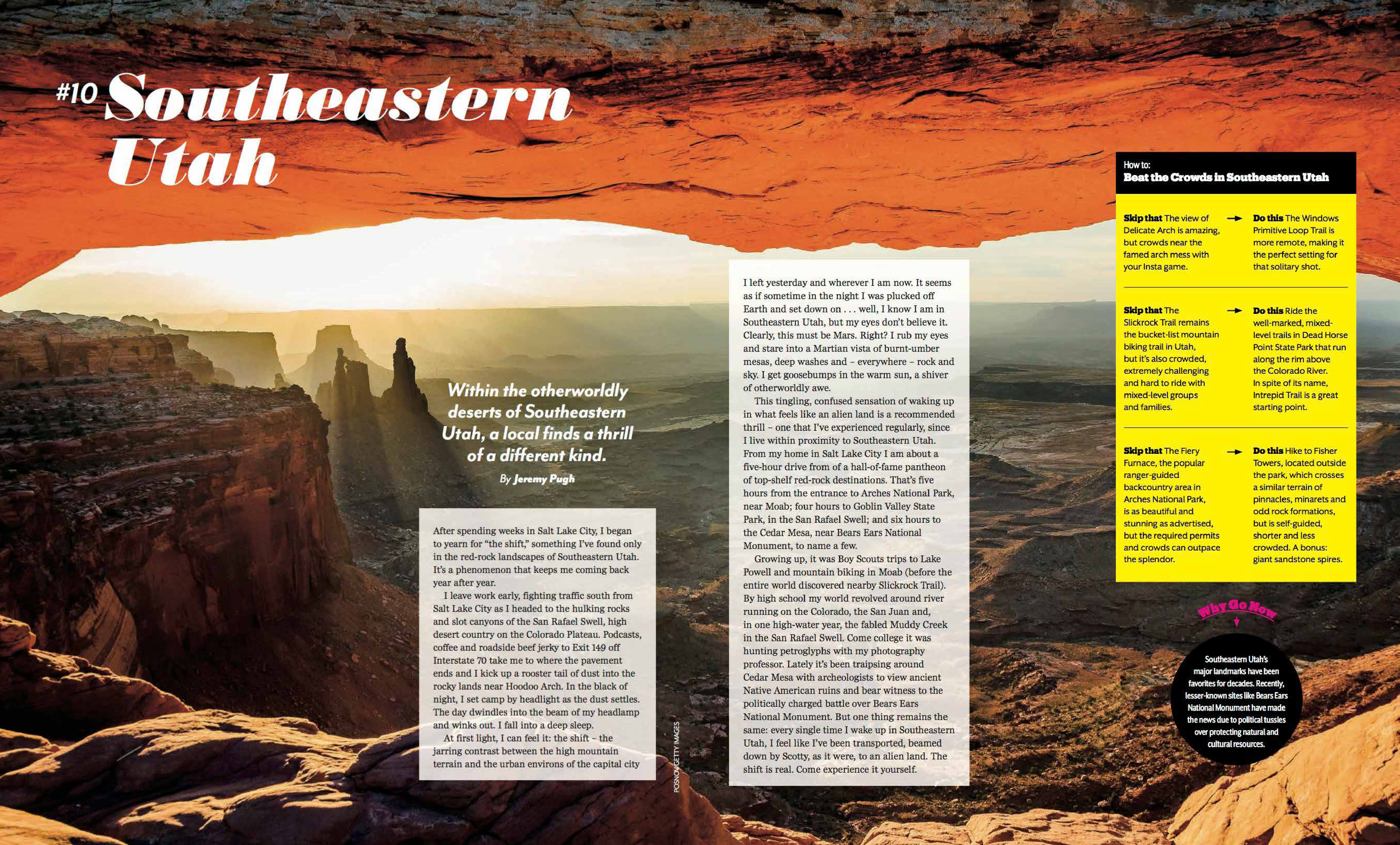
Within the otherworldly deserts of Southeastern Utah, a local finds a thrill of a different kind.
After spending weeks in Salt Lake City, I began to yearn for “the shift,” something I’ve found only in the red-rock landscapes of Southeastern Utah. It’s a phenomenon that keeps me coming back year after year.
I leave work early, fighting traffic south from Salt Lake City as I headed to the hulking rocks and slot canyons of the San Rafael Swell, high desert country on the Colorado Plateau. Podcasts, coffee and roadside beef jerky to Exit 149 off Interstate 70 take me to where the pavement ends and I kick up a rooster tail of dust into the rocky lands near Hoodoo Arch. In the black of night, I set camp by headlight as the dust settles. The day dwindles into the beam of my headlamp and winks out. I fall into a deep sleep.
At first light, I can feel it: the shift — the jarring contrast between the high mountain terrain and the urban environs of the capital city I left yesterday and wherever I am now. It’s as if sometime in the night I was plucked off Earth and set down on . . . well, I know I am in Southeastern Utah, but my eyes don’t believe it. Clearly, this must be Mars. Right? I rub my eyes and stare into a Martian vista of burnt-umber mesas, deep washes and — everywhere — rock and sky. I get goosebumps in the warm sun, a shiver of otherworldly awe.
This tingling, confused sensation of waking up in what feels like an alien land is a recommended thrill — one that I’ve experienced regularly, since I live within proximity to Southeastern Utah. From my home in Salt Lake City I am about a five-hour drive from of a hall-of-fame pantheon of top-shelf red-rock destinations. That’s five hours from the entrance to Arches National Park, near Moab; four hours to Goblin Valley State Park, in the San Rafael Swell; and six hours to the Cedar Mesa, near Bears Ears National Monument, to name a few.
Growing up, it was Boy Scouts trips to Lake Powell and mountain biking in Moab (before the entire world discovered nearby Slickrock Trail). By high school my world revolved around river running on the Colorado, the San Juan and, in one high-water year, the fabled Muddy Creek in the San Rafael Swell. Come college it was hunting petroglyphs with my photography professor. Lately it’s been traipsing around Cedar Mesa with archeologists to view ancient Native American ruins and bear witness to the politically charged battle over Bears Ears National Monument. But one thing remains the same: every single time I wake up in Southeastern Utah, I feel like I’ve been transported, beamed down by Scotty, as it were, to an alien land. The shift is real. Come experience it yourself.
How To: Beat the Crowds in Southeastern Utah
Skip that: The view of Delicate Arch is amazing, but crowds near the famed arch mess with your Insta game.
Do this: The Windows Primitive Loop Trail is more remote, making it the perfect setting for that solitary shot.
Skip that: The Slickrock Trail remains the bucket-list mountain biking trail in Utah, but it’s also crowded, extremely challenging and hard to ride with mixed-level groups and families.
Do this: Ride the well-marked, mixed-level trails in Dead Horse Point State Park that run along the rim above the Colorado River. In spite of its name, Intrepid Trail is a great starting point.
Skip that: The Fiery Furnace, the popular ranger-guided backcountry area in Arches National Park, is as beautiful and stunning as advertised, but the required permits and crowds can outpace the splendor.
Do this: Hike to Fisher Towers, located outside the park, which crosses a similar terrain of pinnacles, minarets and odd rock formations, but is self-guided, shorter and less crowded. A bonus: giant sandstone spires.
Southeastern Utah’s major landmarks have been favorites for decades. Recently, lesser-known sites like Bears Ears National Monument have made the news due to political tussles over protecting natural and cultural resources.