
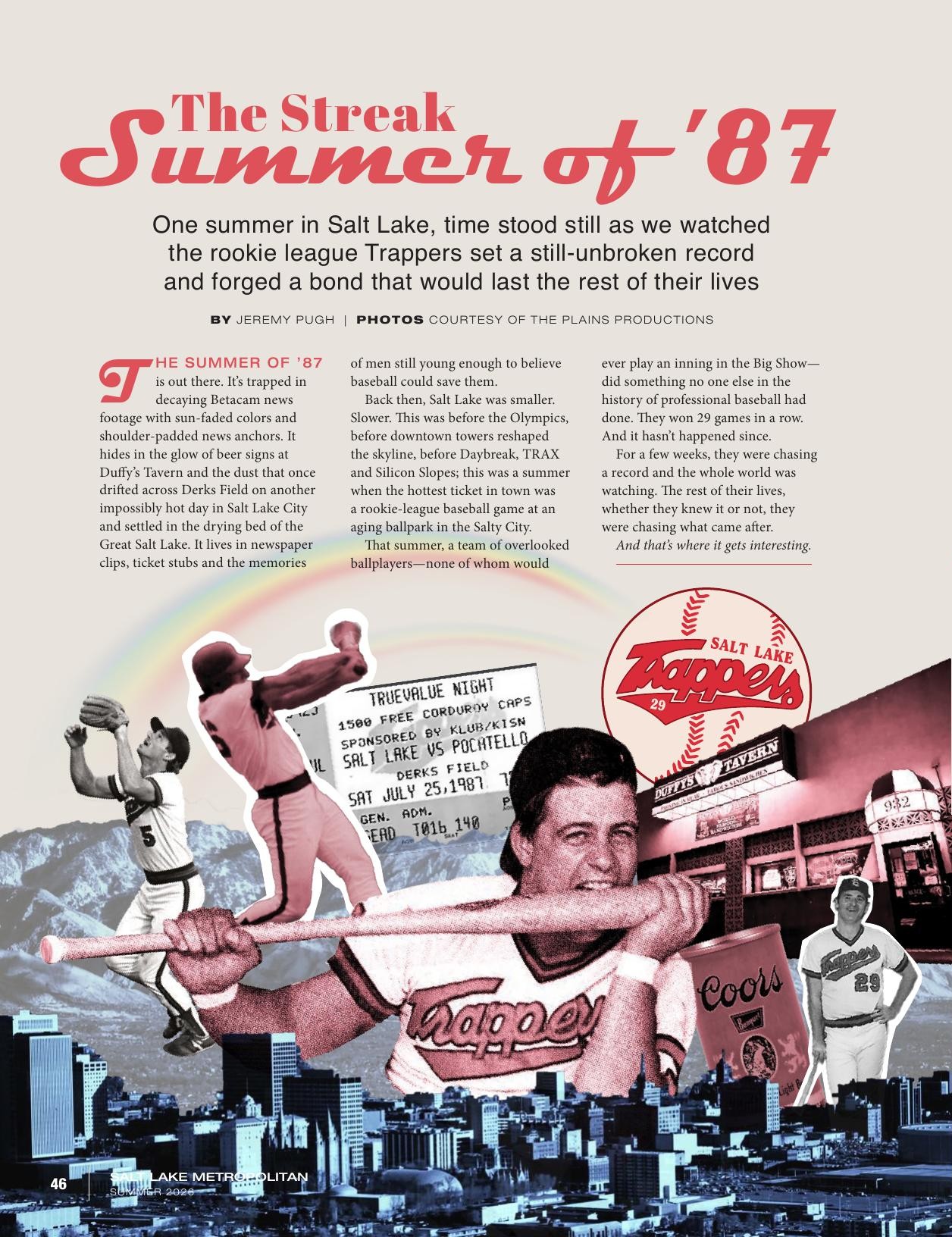
One summer in Salt Lake, time stood still as we watched the rookie league Trappers set a still-unbroken record and forged a bond that would last the rest of their lives.
The summer of ’87 is out there. It’s trapped in decaying Betacam news footage with sun-faded colors and shoulder-padded news anchors. It hides in the glow of beer signs at Duffy’s Tavern and the dust that once drifted across Derks Field on another impossibly hot day in Salt Lake City and settled in the drying bed of the Great Salt Lake. It lives in newspaper clips, ticket stubs and the memories of men still young enough to believe baseball could save them.
Back then, Salt Lake was smaller. Slower. This was before the Olympics, before downtown towers reshaped the skyline, before Daybreak, TRAX and Silicon Slopes; this was a summer when the hottest ticket in town was a rookie-league baseball game at an aging ballpark in the Salty City.
That summer, a team of overlooked ballplayers—none of whom would ever play an inning in the Big Show—did something no one else in the history of professional baseball had done. They won 29 games in a row. And it hasn’t happened since.
For a few weeks, they were chasing a record and the whole world was watching. The rest of their lives, whether they knew it or not, they were chasing what came after.
And that’s where it gets interesting.
The baseball part of the story has been preserved in box scores, newspaper archives and Hall of Fame exhibits. Anyone can look up the number: 29 consecutive victories, the longest winning streak in professional baseball history. The facts fit neatly into a paragraph.
What happened afterward doesn’t.
A pitcher returns home and builds a life. A catcher finds a different career. Players scatter across the country. Some stay connected. Others drift apart. The dream that brought them together—the dream of playing in the major leagues—slowly expires, one roster move and one missed opportunity at a time.
Which is what drew filmmaker Kelyn Ikegami to the story in the first place. Kelyn grew up in Japan and moved to Salt Lake when he was 10 years old. He came to the U.S. with his countrymen’s almost religious reverence for baseball. He was studying film at BYU in 2012 when he encountered the story of the 1987 Trappers’ winning streak.
“It all happened with the 25th anniversary in 2012,” Kelyn says. “It wasn’t me who encountered the story first—it was my producer, Hunter Phillips. We were both in film school and both big baseball fans. He heard that the Salt Lake Bees were hosting the Trappers because they had broken this amazing record, and Bill Murray, a part-owner of the Trappers, showed up to the anniversary.”
His worlds collided. Baseball. Film. And he started looking at the history—more of a hobby, really—but in 2018, he and Phillips started working in earnest on The Streak, a 2025 documentary highlighting not only that summer, but more importantly, what happened to the players’ lives after.
“I love sports documentaries,” Kelyn says. “But I felt like people already knew the history. They could read the Wikipedia page or read an article and understand what happened.”
What interested him was something deeper than baseball.
“Their accomplishment was recognized by the Hall of Fame, which is something most professional baseball players never experience,” he says. “At the same time, none of them reached the major leagues, which was their ultimate goal.”
That contradiction sits at the heart of The Streak. The film begins as a classic underdog sports story—a group of overlooked players chasing an impossible record—but gradually reveals itself as something more reflective. It’s a movie about ambition, identity, friendship and the strange afterlife of youthful dreams.
In many ways, the Trappers were perfectly suited to their moment.
“A 29-game winning streak is almost impossible,” Kelyn says. “I wanted to know: How did they do it? They were a really good team, but they also needed a lot of things to go their way. There were miracle plays, bizarre breaks, rain delays and moments that felt almost impossible.”
The 1916 New York Giants (26) couldn’t do it. The 2017 Cleveland Guardians got close (22). So how did a bunch of guys who weren’t even drafted, on an independent rookie league team, pull it off?
Salt Lake City in 1987 still felt like a large small town. The population hovered around 160,000. Fans knew players by name. Ballplayers ate at the same restaurants every day. They ran into supporters around town. Frank Colston, one of the central figures in the film, remembers living just blocks from Derks Field and eating regularly at the old Coachman’s restaurant near the stadium. They celebrated their wins and licked their wounds after losses at Duffy’s Tavern on Main Street, where Bill Murray was known to hop behind the bar and start pouring beers.
“The baseball community of Salt Lake City was one big Trapper family,” Frank says.
For players who had spent years fighting for opportunities, the city offered something they hadn’t always found elsewhere: belonging.
“What they came to realize,” Kelyn says, “was that everybody was going through the same thing. They all had chips on their shoulders. They’d all been overlooked. They all had something to prove.”
That shared disappointment became a glue.
The more Kelyn spoke with former players during his seven years of research, the more he realized the streak wasn’t merely a baseball achievement. It was the product of a rare chemistry among young men who recognized themselves in one another.
The streak ended long ago. The friendships didn’t.
“More than 35 years later, they’re still friends,” he says. “I was on their group text for a while, and they were texting every single day.”
For Frank, however, the record had become something else entirely. By the time Kelyn tracked him down, he had spent decades putting the story behind him.
“For me, that time had already come,” Frank says. “I had detached from this story completely.”
Baseball had once consumed his life. Then life moved on.
“Emotionally, I probably lived on this story for 20 years,” he says. “Eventually, we all let it go.”
Then the filmmakers called. He ignored them. They called again. And again.
“The guys tried to contact me for several months and I didn’t respond,” Frank says. “Then one day I picked up the phone. Once I talked to Kelyn and Hunter, and understood that their motives were pure, I told them, ‘Come on over.’”
What followed surprised him.
“Some of the guys were picked up by a major league to go play in their minor league system,” Frank explains. “Others weren’t picked up at all, and they all had, you know, a melancholy. Even though it was the greatest summer of our baseball lives, right? It was still bittersweet. And so I knew going into the film that like, ‘If the players can trust me and if they’re willing to like open up about it, then we can actually explore something.’ I would say the majority of us experience having big dreams, and then, maybe, it does not pan out. You kind of have to deal with, well, ‘What is my identity now?’”
But once things started up, the bond they all shared reignited, he says.
“It was like the resurrection of a dead story,” Frank says. “And I mean that in the most positive way. It’s been beautiful.”
That resurrection culminated last year when many of the former Trappers returned to Utah for a reunion surrounding the film’s release. They gathered once again in the city where they had become baseball legends. Older now. Grayer. Wiser. Still carrying pieces of that summer.
That’s what makes The Streak resonate beyond sports. The movie isn’t ultimately about winning 29 games. It’s about what happens when the best summer of your life ends.
It’s about the distance between achievement and fulfillment. About the dreams we accomplish and the ones we don’t. About the friendships that outlast both.
Most of all, it’s about time. A summer in 1987. A long-gone team. A city that no longer exists the way it was. The ballpark is in West Jordan. The Trappers are a footnote to Salt Lake’s baseball past. But not for Frank and the other guys who discovered that sometimes the thing you spend years trying to leave behind is the very thing worth remembering.
And, in the back corner of Duffy’s Tavern, you’ll find a shrine to that summer filled with ticket stubs, jerseys and other memorabilia. Take a moment and hoist a glass to the boys of the summer of 1987. Observe the faded color photos of younger faces who believed nothing was impossible. Frozen in still hollering, yawping moments that will live forever in the back corner of a dive bar.
What About Bill? The Bill Murray Connection
When the Salt Lake Trappers launched in 1985, Murray purchased a small ownership stake as part of a larger investment group that included future Los Angeles Angels owner Arte Moreno, local businessmen and several other partners. His older brother, actor Brian Doyle-Murray, also became closely associated with the club, giving the Trappers a Hollywood flavor despite operating at the lowest rung of professional baseball.
The Murray brothers weren’t absentee celebrity investors. During the Trappers’ early years, both spent time around Derks Field, mingling with players, working promotions and helping cultivate the team’s freewheeling personality. Former players often credit him with helping keep the atmosphere loose during the pressure-filled summer of 1987.
Murray’s appearances became part of Trappers’ lore. The team’s improbable 29-game winning streak gained national attention in July 1987. During the streak, Murray invited Huey Lewis to sing the national anthem, adding to the Trapper Fever that had spread far beyond the ballpark. Derks Field was selling out, tickets were being scalped and a rookie-league baseball team in Salt Lake City had become national news.
Murray wasn’t present for every moment of the streak, but he remained deeply connected to the organization. He returned to Salt Lake City for the team’s 25th reunion in 2012.
“We had 25 rejects and we won 29 in a row, including the championship,” Murray said. “It’s in the Baseball Hall of Fame. It’s a one-time event.”
Kelyn says he tried in vain to get Murray to appear in the film, but couldn’t get his buy-in. Huey Lewis, however, appears for several segments, and Doyle-Murray can be seen in scenes from team reunions.
“We, of course, wanted to talk to Bill. But there was so much more to the story.” Kelyn adds with a grin: “I am, however, still open to his call.”
The Streak (2024) is available for rent or purchase on Amazon Prime Video or Apple TV. If you grew up in Salt Lake during the ’80s, it’s full of scenes, faces and places you’ll recall.
Originally Published in Salt Lake Metropolitan, A City Journals Publication.