
Originally published in Westminster Review magazine (Fall 2012). From 2012 to 2014, Jeremy Pugh served as consulting editor for Westminster College’s alumni magazine, working with the school to improve the editorial quality and impact of its flagship publication. Portraits by Adam Finkle.
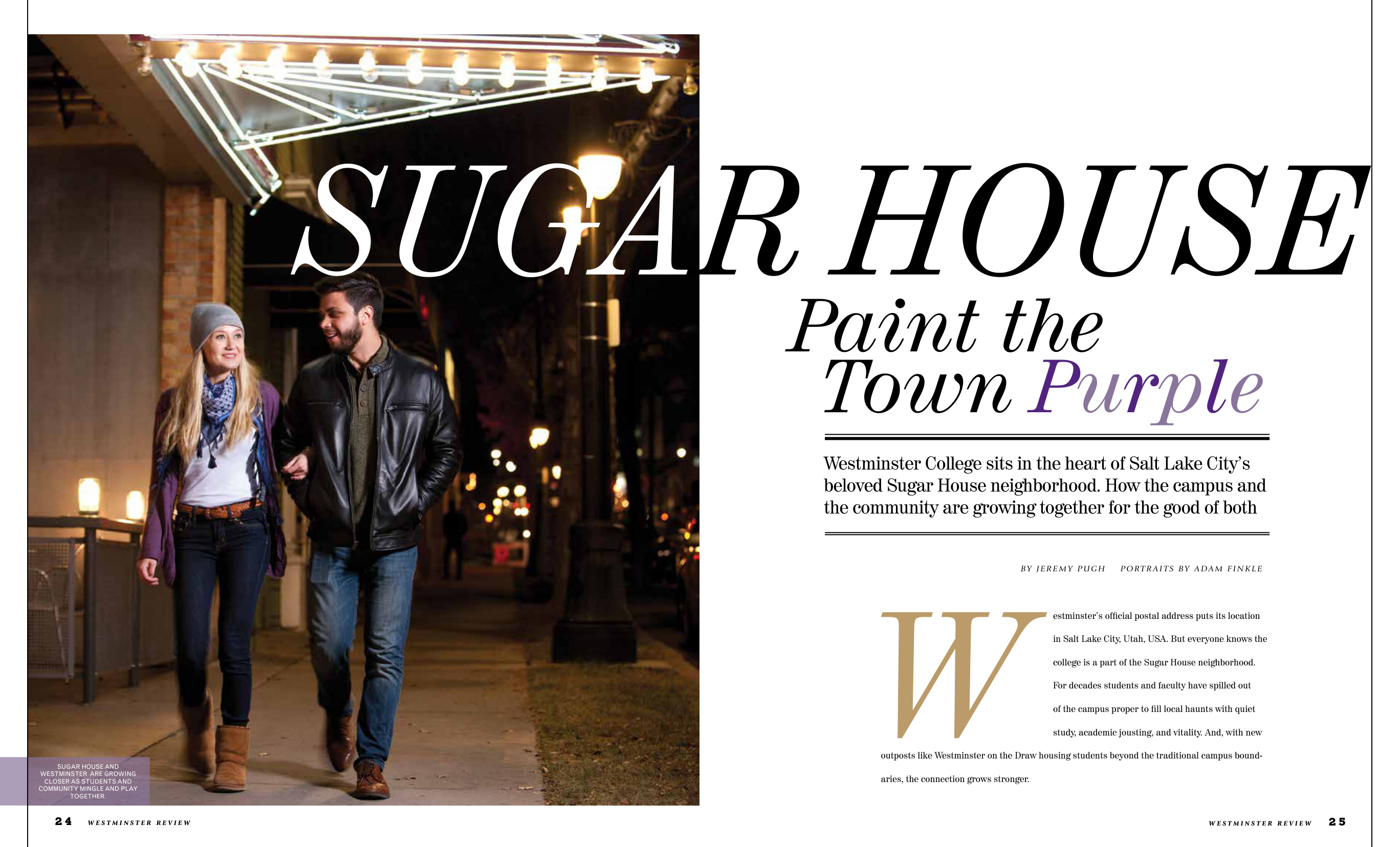
Westminster College sits in the heart of Salt Lake City’s beloved Sugar House neighborhood. How the campus and the community are growing together for the good of both.
Westminster’s official postal address puts its location in Salt Lake City, Utah, USA. But everyone knows the college is a part of the Sugar House neighborhood. For decades students and faculty have spilled out of the campus proper to fill local haunts with quiet study, academic jousting, and vitality. And, with new outposts like Westminster on the Draw housing students beyond the traditional campus boundaries, the connection grows stronger.
Over the last decade, the college and the neighborhood around it have quietly been growing together: talking, planning, making connections, and establishing an identity that more deeply embeds our beloved bucolic campus into the heart of a growing and changing Sugar House.
As Westminster’s historical boundaries grow more fluid and transparent, the college’s connection to Sugar House becomes more important. Each entity must consider the other in important decisions about growth, development, and transportation. College decision-makers recognize that the vibrancy of Sugar House greatly enhances the quality of student life and learning. On the flip side, merchants and community members see the value of the college: the plays, lectures, musical performances, and athletic events enrich the neighborhood; and the local merchants recognize that students, faculty, and staff are good for business and add to Sugar House’s vitality.
The Turning Point
It wasn’t always this way. Westminster’s community relations director, Annalisa Holcombe (’92), can remember a time that the campus was looking inward. While the neighbors were always welcome, the campus community wasn’t always thinking to the community beyond.
“The campus had been facing the Commons,” she says. “We welcomed everyone, but I see how it could have felt unwelcoming to people who were not a part of our campus.”
Holcombe’s first few meetings with community members were often difficult. Neighbors regularly viewed the college administration with mistrust and were under misconceptions about the students. After one of the more difficult community meetings, Holcombe describes having a light-bulb awakening.
“We thought a few people would come; 150 showed up,” she recalls. “And there were Mark [Ferne, dean of students] and I standing up there. I felt like they were waving pitchforks.”
That moment remains in Holcombe’s mind as a turning point. She saw it as a moment to seize and a goal to work toward: making a connection.
“At one particular meeting some of the neighbors were so mad,” she says. “I remember them making shockingly disparaging comments and accusations about the students at Westminster. I actually choked up. I reminded them that they were talking about people [students] I cared about and that our students weren’t the kids they were making them out to be. I realized then and there that we really needed to humanize Westminster, to start talking and not just be a faceless institution.”
“The University of Utah is all over the place. But Sugar House is more of a community. When I come to Sugar House, I see my fellow Westminster students. It’s cool. I really like that it’s the heart of Salt Lake City.”
— Amanda Jones (’18), freshman
Joining the Conversation
Sugar House community council chair Amy Barry remembers that moment and believes that, in its aftermath, a breakthrough in Westminster-Sugar House relations occurred. Then-Westminster President Michael Bassis supported Holcombe, a member of his presidential cabinet, in her suggestion to join the Sugar House Community Council.
“I was determined to help us truly be part of the community,” she says. “I figured that if we were sitting on the community council and helping to tackle the issues in our community on a daily basis, we wouldn’t be the ‘institution’ that only engages in community issues when we need help: we’d be a true neighbor—side by side trying to make our community a better place.”
Barry says she saw a legitimate “walking the talk” moment. “It showed that Westminster wanted to work to tie its student body to the broader Sugar House neighborhood and business district. We saw that its leadership was serious about building the connection, and they wanted to be more than just a school plopped down in the middle of town. It showed that they really wanted to be part of the community.”
The council has been around since the 1970s and elects trustees from areas within Sugar House to represent their neighbors in matters that affect the community as a whole. When Westminster placed a high-ranking staffer like Holcombe on the council, it was a big deal, Barry says.
Holcombe then joined the Sugar House merchant’s association. “Nobody knew about the merchant’s association,” says former association member Silvia Castro. “There was a lot of potential, but there was no focus. We have a really unique set of merchants in Sugar House, and when Annalisa joined, she started involving students. We call her ‘Miss fix it.’ We asked her to be chair, and she started involving students and really made it more inclusive.”
Westminster’s role in the merchant’s association helped get more businesses involved, and last year it became the Sugar House Chamber of Commerce, representing more than just businesses and increasing its membership nearly 300 percent.
A College Town
The vision was always there. In 2009, a conversation was happening on campus: the topic was designing a blueprint that would create a “college town.” Westminster wanted to work toward building a symbiotic relationship between the neighborhood that surrounds it and the Westminster campus’ traditional boundaries. To that end, Westminster drew up a long-term plan to codify its continued outreach and participation in Sugar House’s growth and evolution. Titled plainly “Sugar House and Westminster: The Next 25 Years,” the plan formally spells out the need for Westminster to work together with Sugar House community leaders to enhance the community.
“Sugar House is evolving into a community that resembles a college town,” the report states. “It benefits from the enhanced presence of Westminster students, faculty, and staff through increased economic activity, enhanced transit, recreational and educational opportunities, and improvements to space and facilities. Westminster College benefits by providing its students with expanded opportunities for community-based learning and for employment, recreation, entertainment, and housing.”
Lynne Olson, a local writer and long-time active Sugar House community member, says that all the pieces are in place for Sugar House to continue to be a “college town” for Westminster. “There are so many benefits to having a college in our community,” Olson says. “So many things happen on campus, and we all get to benefit from having it right in our back yard. It’s good for everybody in that regard.”
And while the University of Utah may have its giant football teams, big-time rivalry with Brigham Young University, and all that hoopla, Sugar House and Westminster are quietly becoming a college town, nestled into the larger city.
“I went to the University of Montana in Missoula and the University of Utah,” Barry says. “The U is just a commuter school, so different from Missoula, which is truly a college town. Westminster and Sugar House have the potential to grow into the connected college town where everyone takes pride in the school.”
Sugar House Hot Spots
Sugar House has seen a lot of change over the last even five years. But as construction finally ends in the central business district, things are coming into focus. Westminster students and faculty have plenty of places to eat, play, and shop in Sugar House. A few favorites at the time: Sugar House Coffee (“the other library,” students called it), Fiddler’s Elbow, Wasatch Brewpub, Joffee’s Coffees, Omar’s Rawtopia, Sugar House Pub, and Mellow Mushroom Pizza.
Business Smarts: A Student Consulting Program
A few years before this story ran, the Westminster Community Relations Office started a student consultant program pairing students with local business owners. Business owners got the students’ expertise developing business plans and marketing strategy; students got real-world experience solving problems for actual clients. Holly King (’14) worked with the Sugar House Paint Mixer, a painting-and-wine studio that had expanded from Park City into Sugar House, to sharpen its social-media strategy.
“It’s not you going into some office and having someone tell you what to do,” King said of the program. “You have a company saying, ‘Here are our issues’ and asking you how to fix them.” Her takeaway: “It was the first time that I had ultimate control and responsibility. The Paint Mixer wasn’t my boss. I was hired by the Community Relations Office at the college, and the Paint Mixer was my client. It was a really good learning experience for me.”
“So many things happen on campus, and we all get to benefit from having it right in our back yard. It’s good for everybody in that regard.”
— Lynne Olson