
Originally published in Westminster Review magazine (Fall 2012). From 2012 to 2014, Jeremy Pugh served as consulting editor for Westminster College’s alumni magazine, working with the school to improve the editorial quality and impact of its flagship publication. Portraits by Chris Jameson.
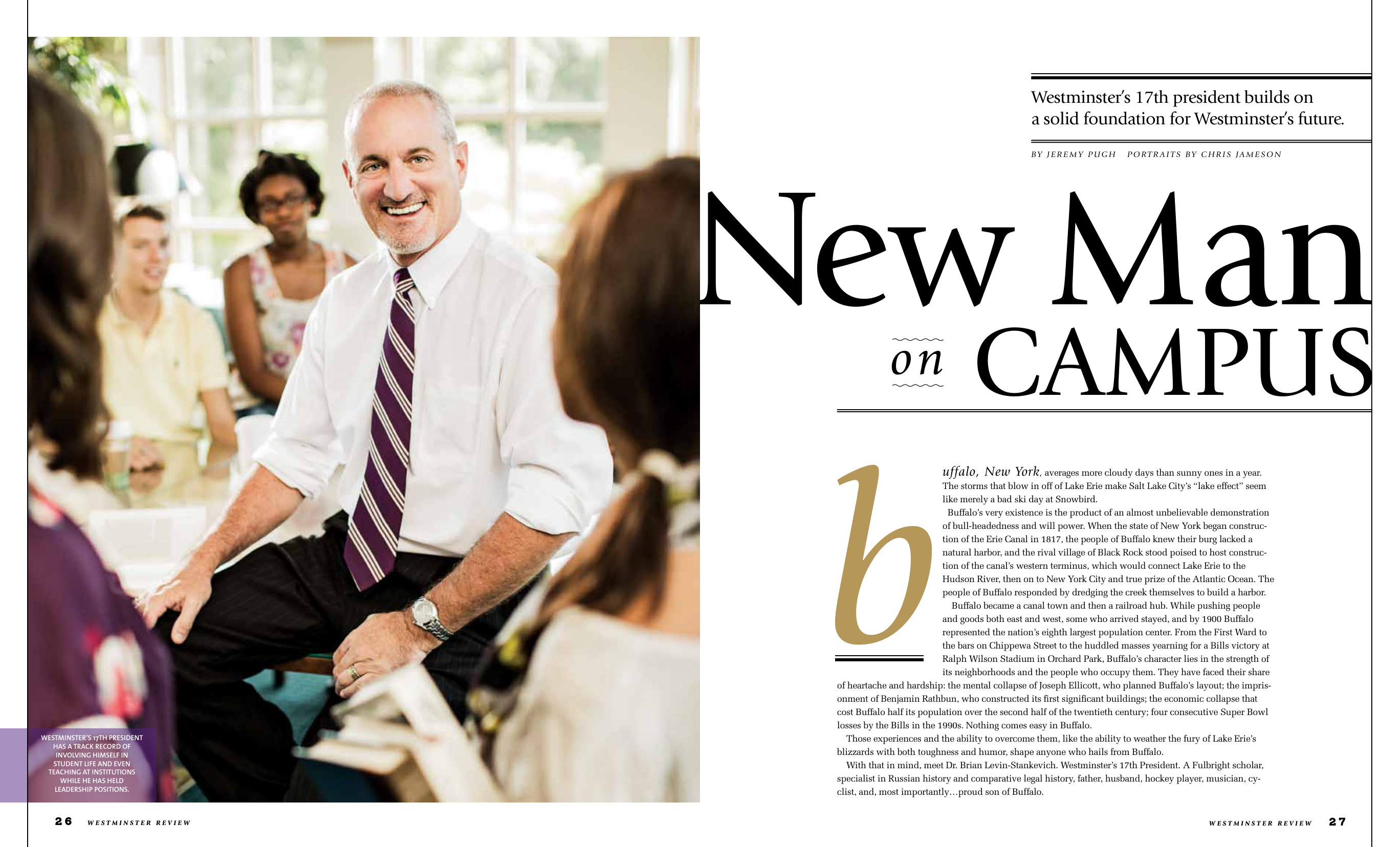
Westminster’s 17th president builds on a solid foundation for Westminster’s future.
Buffalo, New York, averages more cloudy days than sunny ones in a year. The storms that blow in off of Lake Erie make Salt Lake City’s “lake effect” seem like merely a bad ski day at Snowbird.
Buffalo’s very existence is the product of an almost unbelievable demonstration of bull-headedness and will power. When the state of New York began construction of the Erie Canal in 1817, the people of Buffalo knew their burg lacked a natural harbor, and the rival village of Black Rock stood poised to host construction of the canal’s western terminus, which would connect Lake Erie to the Hudson River, then on to New York City and true prize of the Atlantic Ocean. The people of Buffalo responded by dredging the creek themselves to build a harbor.
Buffalo became a canal town and then a railroad hub. While pushing people and goods both east and west, some who arrived stayed, and by 1900 Buffalo represented the nation’s eighth largest population center. From the First Ward to the bars on Chippewa Street to the huddled masses yearning for a Bills victory at Ralph Wilson Stadium in Orchard Park, Buffalo’s character lies in the strength of its neighborhoods and the people who occupy them. They have faced their share of heartache and hardship: the mental collapse of Joseph Ellicott, who planned Buffalo’s layout; the imprisonment of Benjamin Rathbun, who constructed its first significant buildings; the economic collapse that cost Buffalo half its population over the second half of the twentieth century; four consecutive Super Bowl losses by the Bills in the 1990s. Nothing comes easy in Buffalo.
Those experiences and the ability to overcome them, like the ability to weather the fury of Lake Erie’s blizzards with both toughness and humor, shape anyone who hails from Buffalo.
With that in mind, meet Dr. Brian Levin-Stankevich. Westminster’s 17th President. A Fulbright scholar, specialist in Russian history and comparative legal history, father, husband, hockey player, musician, cyclist, and, most importantly…proud son of Buffalo.
Three Blocks Wide, 18 Blocks Long
Levin-Stankevich grew up in Kaisertown—a tight immigrant neighborhood in the Old First Ward of Buffalo. It was, in his recollection, 18 blocks long and three blocks wide. In this relatively small rectangle there were three Catholic parishes and 24 bars. For young Brian Stankevich, it contained his whole world.
“You didn’t get away with anything,” he says. “If you got into a boyhood fight with somebody 10 blocks away, by the time you got home your mother knew about it.”
Levin-Stankevich is a first-generation college graduate, a distinction he attributes to a respect for higher education that permeated the community. He attended parochial school with the clear expectation from his working-class parents that he would go further in his education than they had.
“I remember the most educated person in our neighborhood would be called the ‘professor,’” he says. “Now, they weren’t necessarily professors, but there was always that respect for higher education.”
“At that time there was an opportunity for blue-collar workers to enter the middle class,” he says. “To have a house, have a line of credit, to enjoy life that was relatively free of economic fear. I owe a lot to the people who worked hard to give me a college education. Everyone should have the chance to have their children reach for it.”
Crossing Borders
Levin-Stankevich’s boyhood in Kaisertown had an interesting international twist to it. Buffalo sits across the Niagara River from Canada. Growing up, he crossed over the border often, and his family watched both Canadian and American news broadcasts.
“The different perspectives sunk in, and if you live in Buffalo, you go back and forth between Buffalo and Canada all the time,” he says. “You notice the little differences, and then you realize that there’s this other country over there, and I learned a lot from crossing the border.”
So when it came time for him to go to high school he opted to cross the invisible border of his neighborhood and venture out into the larger city. He chose Canisius High, a Jesuit school on the other side of town—a long way from home at the time. That instinctive cross-the-border-and-seek-different-experiences mentality would soon become his modus operandi at every major stage of his life, eventually leading him far from Kaisertown to remote points around the globe.
His next leap was to Hamilton College, three and a half hours from home but, as he says, a world apart. In his sophomore year, Levin-Stankevich met his first academic mentor, Mike Haltzel, then a professor of Russian and German history who later became a key foreign policy advisor to then-Sen. Joseph F. Biden and the Senate Foreign Relations Committee, and is now a senior fellow at the Johns Hopkins School of Advanced International Studies. Levin-Stankevich took every course he could from Haltzel, all the way through his senior thesis. “In college you find your little academic niche and become known for that,” he says. “I became the Russian guy.”
“In college you find your little academic niche and become known for that. I became the Russian guy.”
To Russia With Love
A baccalaureate in history under his belt, Levin-Stankevich returned to Buffalo to attend graduate school at SUNY Buffalo. He met Debi, then a junior at Buffalo State, across a crowded room at a local watering hole called Mr. Goodbar. After “a rather quick courtship,” the young couple moved in together, and 20 months later (after Debi affirmed her love of hockey) they were married. Three years after, Brian and Debi went to the Soviet Union on a Fulbright fellowship to conduct research for his dissertation.
The young couple lived in a one-room apartment (about half the size of Westminster’s presidential office, Brian says) in exactly the type of building you’d imagine during the drab height of Soviet-era construction. They had a hot plate and infrequent hot water, and used the windowsill and the perpetual cold of Leningrad as a refrigerator. At the time, there was only a handful of other Americans in the city of four-million Soviet citizens. At first it proved to be a very isolating experience, but the Levin-Stankeviches were curious and outgoing people who soon made friends, in spite of Cold War tensions.
“The Russians were just curious about America, and they loved Americans and American culture,” he says. “Neither we nor they felt a great deal of responsibility for the policies of our governments. So we made a lot of good, very intense friendships with Leningraders in a very short period of time.”
They also discovered a release valve via a friendship with the American Consul General and his golden retriever. The couple was asked to house- and dog-sit—in a former Tsar’s palace, filled with western delights. “We could do our laundry, had hot water, and finished a tin or two of leftover caviar,” Debi says. But everyday life in Leningrad, for Debi, mostly meant shopping. “You had to shop a lot of the time, because there was no sort of inventory,” she says. “You didn’t say I’m going to the store to pick something up, because they probably didn’t have it. So you wandered between the street stalls and the stores that you knew. When something became available, you stockpiled it.”
Back From the USSR
So the continual expansion of Levin-Stankevich’s world view that started with his first steps out of Kaisertown brought him, at first, back to SUNY Buffalo, teaching history. Since then, he has worn nearly every hat the world of higher education administration has to offer, taking him around the country from Florida to Washington, Wisconsin to Utah—including a stint as Chancellor of the University of Wisconsin-Eau Claire (2006–2012) and interim president of Eastern Washington University (2005–2006).
Now landed in Salt Lake City, at what one assumes will be his final posting, Levin-Stankevich is looking forward to implementing a career’s worth of practical experience and knowledge here at Westminster. Getting to know the staff and faculty who were around and meeting board members and community leaders, he spent the summer in a house near campus before settling into the presidential home. And, like Henry V on the eve of battle, he’s shown up incognito at backyard barbecues and block parties and gone on tours of the mechanical workings of the campus—kicking the tires as it were.
Levin-Stankevich’s working-class sensibility informs him: he is proud of where he came from and of his parents. His goal is to protect the value of the baccalaureate degree while advancing a culture of respect and diversity on campus.
“We do this because we need well-educated citizens of the future,” he says. “The baccalaureate degree means more than just a collection of credits.”
“Dr. Brian” (as students call him) had a very strong academic drive, one that has served him extremely well throughout his career. But don’t let his new role as president fool you: he fully intends to do something unusual for an administrator—to get into the classroom and teach. Why? He wants to ensure he doesn’t lose sight of what is really important in academia: a solid foundation that inspires lifelong learning—the same lifelong learning that spurred his academic drive and led to a stellar career for “the Russian guy.”
Westminster’s 17th President Brian Levin-Stankevich was installed on October 20, 2012, in a ceremony held at the Dolores Doré Eccles Health, Wellness, and Athletic Center’s Behnken Field House, coinciding with Westminster’s Alumni Reunion weekend.