
Originally published in Westminster Review magazine (Fall 2012). From 2012 to 2014, Jeremy Pugh served as consulting editor for Westminster College’s alumni magazine, working with the school to improve the editorial quality and impact of its flagship publication. Co-written with Robin Boon.
It’s 1957. A middle-aged couple is up in the night, crunching numbers at their dining room table. The husband, a chemist, has the opportunity of a lifetime—to own the commercial development rights to a polymer with properties diverse enough to provide a non-stick surface in the bottom of a frying pan and insulate electrical wiring in mainframe computers. In the lab at DuPont, he has performed experiments proving the polymer’s possibilities are great.
Known by material scientists as polytetrafluoroethylene (PTFE), the polymer’s trade name, Teflon, is a household word. Yet the management at DuPont is not interested in further developing this plastic.
The chemist is Bill Gore. His wife, Vieve, believing in her husband, suggests that they gather their resources to create their own company—all at a time when they have two kids in college and three younger children sleeping down the hall.
“They were both adventurers,” recalls their daughter, Ginger Gore Giovale. “Dyed-in-the-wool Utahns. They loved mountain climbing, sunsets, hiking the countryside.”
Bill and Vieve Gore signed the paperwork creating W. L. Gore & Associates on their wedding anniversary—January 1, 1958—embarking on what would become their greatest adventure together. And, like most of their adventures, they brought their family along.
Basement Laboratory
The Gores’ mid-century modern home, built by Bill on 15 acres of Delaware farmland, became the first headquarters for their fledgling enterprise. Lacking a real laboratory, they repurposed the basement and raided the kitchen. Additional ovens were installed. Decommissioned culinary appliances were pressed into alternative service. Random measuring cups here, a reassigned electric skillet there.
“The basement manufacturing just happened to be under the bedroom my sisters and I shared,” recalls Ginger. “Everything was smelling bad, and we were missing essential things like the blender and the best pots in the kitchen and the measuring cups! Sometimes I’d look at the measuring cups when we were cooking, and I’d think, ‘Do I really want to measure anything in it?’”
America was in the midst of a chemical revolution and in an age of optimism about the future. Material scientists had created polymers with names like Dacron and Nylon. In the Gores’ basement, a motley team of friends and family was experimenting with one of the greatest polymers in history, transforming lives and industries around the world—a start-up well before the term “start-up” came into vogue. Long before Jobs and Wozniak worked out of a garage to create Apple computers, Bill and Vieve Gore and their son, Bob, paved the way in their Delaware home.
Ginger describes that posse in the basement: “a group of relatives, a one-legged mechanic who used to work at a gas station nearby, and it was friends and the friends’ friends and so on…it was a ragtag bunch of people.”
Bill Gore loved being the pied piper of this ragtag collection of associates with a cool new material. In contrast to the white-jacket-chemist-in-the-lab stereotype, Bill was an extrovert who took great joy from selling their new ideas for Teflon. It wasn’t long before he and Vieve realized they had found their niche as entrepreneurs.
Initially, they found that manipulating PTFE, flattening it or thinning it, produced properties that were perfect for electrical insulation. And so it began: insulated wires became their first product. A machine twisted wires into pairs. On one occasion, Ginger recalls, when the twisting machine broke, they simply laid everything on the lawn and twisted it by hand, and any imbedded grass got yanked out.
Those first years were tough financially. Associates, many of whom were close relatives and friends, were occasionally paid with shares of stock. During the early days, the company was really more of an extended family than a typical corporation.
Computer giant IBM placed the biggest orders. And as the computer industry grew, so did W. L. Gore & Associates. In 1961, they moved into their first manufacturing facility. As demand for cable grew, they realized the need for a plant closer to their customers. They traveled the West checking on transportation, higher education, and looking for nearby mountains to climb. In each community, they asked, “Would we want our associates to move here?”
In 1967, they settled on Flagstaff, Arizona, where today 14 plants thrive. From there, they spread into Europe, then Asia. Ginger explains, “It’s an amazing spread of success and the Gore philosophy.”
Although those not-so-mad scientists in the Gores’ basement cooked up multiple uses for PTFE, the game changer came in 1969 when Bob Gore discovered a new technology that nobody expected—expanded PTFE, or ePTFE. “He found that by heating and stretching Teflon, it puffed up like a marshmallow, changing its basic structure,” explains Ginger. “That discovery brought us a whole new way of thinking about the uses for PTFE.”
Many years of development with ePTFE resulted in GORE-TEX® laminate, as well as many other products that aren’t as commonly known but benefit people and businesses worldwide. Today, global sales exceed $3 billion. The company that had a risky start in 1958 in Delaware now has 10,000 associates operating on every continent on earth, except Antarctica (although a lot of GORE-TEX® apparel is worn there).
The Westminster Connection
The heart and soul of the enterprise were, respectively, Vieve and Bill Gore. They met in the 1930s. Westminster had actually been a part of the Gore family for earlier generations, as Bill’s mother, Dora Clark Gore, and others had graduated from Westminster in the early 1900s.
The Gores’ connection to Westminster continued to grow. In 1977, Bill was asked if he would become a trustee. He graciously declined and suggested they consider his daughter Ginger. President Helmut Hoffman called Ginger and invited her to visit campus to get acquainted. She did and accepted the offer to be a trustee.
As a young woman expecting a baby, Ginger was hardly the average board member for her era. The time between her campus visit and her first meeting was several months, which added a certain air to the meeting. Sitting at a table with 12 men gazing at her, Ginger thought to herself, “They’re all looking at me and whispering to each other, ‘Geez, she sure put on a lot of weight!’” She explained, “I’m sure I’m the only board member who was ever pregnant while serving on the board.”
The Gore School Cometh
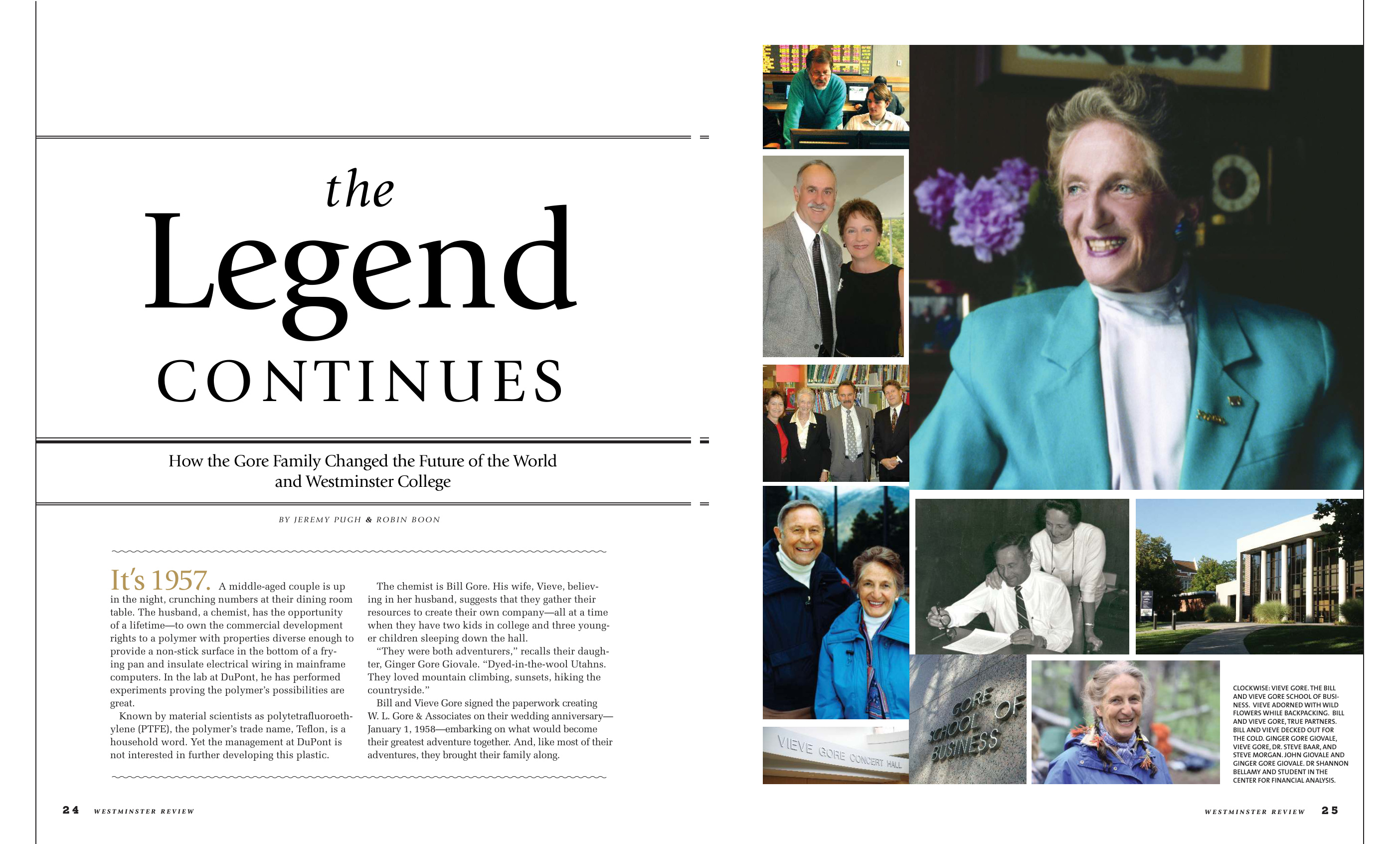
After Bill’s death in 1986, Ginger and Vieve remembered that he had intended to make a substantial donation to the college, but Bill had died before fulfilling that dream. “At that point,” Ginger says, “I realized that I was Dad’s Westminster legacy.” At the time, Westminster’s financial stability was a little dicey, but Ginger and her mother knew the organization well; they believed in its strong leadership and accomplished faculty, and they felt Westminster, at its core, was stable. Together, they founded the Bill and Vieve Gore School of Business in 1988 with this ribbon-cutting gift becoming a turning point for Westminster.
In 1990, after some estate planning, Vieve decided to donate the $7 million in Bill’s retirement account to the college. This significant donation, in addition to her Gore School of Business and Challenge for Freedom gifts, demonstrated Vieve’s commitment to Westminster.
Ginger is proud of what has taken place in the Bill and Vieve Gore School of Business, particularly its strong leadership, starting with Dean Charlie Ehin, then Dean Cid Seidelman. Cid opened the aviation program, along with the MBA program. Now the school is being considered for accreditation with the Association to Advance Collegiate Schools of Business, all of which are accomplishments about good thinkers and good leaders. It pleases Ginger to see Dr. Jin Wang as Dean, who knows both faculty and students will gain an even better sense of business in a global economy.
Ginger continued to serve on the Westminster board for 29 years, retiring in 2006. She dedicated 18 of those years of leadership as board chair and remains one of the longest continuously serving trustees in Westminster’s history.
Bill and Vieve were innovators, creators, and they were also Utahns, enamored by the West. They were healthy, active people who loved camping, hiking, and backpacking, anything to do with the outdoors. Both Bill and Vieve were among some of the intrepid testers of the GORE-TEX® fabric—its successes and its failures—testing its limits with long backpacking trips.
In fact, Bill’s favorite outdoor activity was backpacking. It was one of two traditional two-week-long backpacking trips with Vieve and a grandson that Bill Gore died of a heart attack in the rugged Wind River area in Wyoming. Ginger said, “Oddly enough, it made us feel a little bit more at peace to think that he was out there doing what he loved. It was just so appropriate. So him.”
How to Succeed in Business the Gore Way
While the Gores are responsible for creating an inordinate number of innovative products, the organization is equally legendary for Bill Gore’s greatest “discovery”—a team-based, flat lattice organizational structure, developed by Bill to “foster personal initiative.” W. L. Gore & Associates sustains a culture built around Bill’s deeply held beliefs—a philosophy that fosters an environment of trust, respect, and teamwork that encourages innovation and creativity.
To begin with, Gore has no “employees.” All individuals who work for Gore are “associates.” There are no organizational charts, no chains of command, no bosses (but “sponsors”). Everyone is accountable to his or her team. Leaders are defined by “followership.” The fundamental difference is that in Gore, associates become leaders by gaining the respect of colleagues and peers, rather than the support of a boss.
W. L. Gore & Associates arose from Bill’s experience with DuPont. Had he been allowed to work on that little polymer, DuPont would have realized huge profits. So Bill created a culture that encourages freedom for creativity: at Gore, associates are free to talk to anyone in order to do their jobs. There are no formal channels to navigate.
There is a commitment to four principles, but no “fighting your way to the top,” rather, gaining followers. The company could be said to have a very “unbusinesslike” style. Provost Cid Seidelman recounts the time when the Gores were considering Western cities in which to build. When then-Utah Governor Norm Bangerter asked, “How many employees do you have?” Bill replied, “Well, we don’t have any employees.” That puckish response was typical of Bill and Vieve being playful. Cid’s favorite is Bill’s response to a new hire who asks, “What should I be doing?” Answer: “Look around and see what needs to be done.” Another legendary reply was about his visit to the new Flagstaff operation: “Oh, they are doing wonderfully. They’re making SO many mistakes.”
Cid recalls Vieve as being incredibly smart, very perceptive around people, very playful, and asking questions. She was an equal partner in the team. Ginger concurs. “Mom and Dad did everything together. When Dad would go to a technical meeting, Mom would go to the technical meeting. He wanted her to be there. Mom was a people person. When visiting plants, Dad would meet with the scientists. Mom would find the accounting and human resources people. She made heroes. When she learned what someone was doing, she’d tell them, ‘I think you’re doing something wonderful.’ She’d make them feel like a hero—and then they would be a hero. She made Dad and Bob heroes, simply by saying what a wonderful job they were doing.”
Many companies try to emulate the flat lattice culture, and there is considerable debate about altering an existing culture, rather than starting a new one that already exists. Can you create a Gore-like culture in one that already exists? Dr. Michael Pacanowsky, who knows W. L. Gore & Associates from the inside out, can answer that question. This fall he joined Westminster as the first Ginger-Giovale Chair in Business Innovation. His new role, in addition to teaching, is to write a book about the unique Gore culture, and he will reveal the difference between Gore 101 and Gore 401 (Intro and reality).
Bill Gore’s Four Principles of Gore
Which have been the framework for the company’s philosophy since its inception: Freedom — Each of us will allow, help, and encourage others to grow in knowledge, skill, scope of responsibility, and range of activities. Authority is earned through the power of followership. Fairness — Each of us will try to be fair in all our dealings: with each other, with our suppliers, with our customers, within our communities and with all people with whom we have transactions or agreements. Commitment — Each of us will make our own commitments—and keep them. No associate can impose a commitment on another. All commitments are self-commitments. Waterline — Each of us will consult with appropriate associates who will share the responsibility of taking any action that has the potential of serious harm to the reputation, success, or survival of the enterprise. Our enterprise is like a ship that we are all in together. Boring holes below the waterline could sink our ship.
Get to Know Dean Jin Wang
Dr. Jin Wang walked between villages in the mountains of China. As a young man, he was tasked with ensuring the quality of high school education in 12 villages, and the only way to travel among them was on foot. That was his first job ensuring quality education.
Fast forward past his years at Zhongshan University, then on to Ohio University and Kansas State, to the time when his title reads “Doctor.” After teaching for several years, he became Associate Dean of the College of Letters and Science at the University of Wisconsin–Stevens Point. At the university, he worked with students of all majors, who came into the arts and sciences for general education degrees.
“Working in arts and sciences gave him the opportunity to impact each student on campus in some way, and he knew the value of the arts for their education. So he decided to continue working in liberal arts. This type of education is so important for professional programs,” he said. “It gives students the foundation they need—the skills, capacity, and knowledge—to apply critical thinking, communication and speaking to their professional lives.”
As a Dean at Westminster, he has set goals to ensure that students of the Bill and Vieve Gore School of Business have ample opportunities to apply their liberal arts educations. He has established and extended partnerships between Westminster and universities abroad. He has created a board of advisors to help guide the school’s decisions. He has also made a global perspective a priority, and revised the school’s vision statement to better reflect a goal of being regionally and nationally recognized.
“At my age, your selfish desire is less, and your desire for society grows,” he said. He knows he’s been fortunate to have opportunities to learn and to benefit from his education. He wants students to have the opportunities he had and more. He does not only help students get jobs, but he also wants to help them make a difference for the better in local and global society.
A Sampling of Bill and Vieve Gore School of Business All-Stars
The Bill and Vieve Gore School of Business has generated top talent in the business world. A few standouts: Mark DeYoung (MBA ’86), President and CEO of Alliant Techsystems (ATK); Rebecca Brown Jensen (’02, MBATM ’09), CEO of Wasatch Front Multiple Listing Service; Ray Bradford (’07), partner at Kleiner Perkins Caufield & Byers; Scott Beck, President and Chief Operating Officer of CHG Healthcare, MBA ’94; and Lisa Gough (MBA ’07), President of Sysco Intermountain.
GORE-TEX® Laminate: The Worldwide Miracle
The most well-known creation of W. L. Gore & Associates is yet another derivative of that magical compound ePTFE, known the world over as the gold standard in waterproof/breathable outerwear: GORE-TEX® fabric. Family lore has it that Bill and Vieve suffered through a rainy backpacking trip in a leaky ePTFE-coated tent, spurring efforts to improve the product. What emerged was the material that breathes and lets out moisture as it protects from the elements. Not only is the GORE-TEX® laminate a miracle for outerwear, it has medical, electronic, and industrial applications. Gore makes stent-grafts to combat vascular disease and textile products for hernia repair. Gore products are used in automotive vents, computers, and cooling filters.